

I collected real use cases of TrackLab. As I’m the only user, all these cases are mine 😁. The thing is that TrackLab is a 100% offline app. That means I’m not able to see the stats on how many users there are.
Sleep
problem
My sleeping routine was messed up. I watched short videos until I passed out at 2-4 A.M. Needless to say, the next morning I felt broken. I knew that I should recover, but I didn’t see any sense in trying, because watching short videos was so tempting. My brain worked in “enjoy now -> suffer later” mode.
As I mentioned in my previous post, in such a situation you need to prove to your brain benefits of good habits. It must be a good deal; otherwise nothing will change.
Plan
My plan was to measure my energy level with no changes first. Soon I understood that it was impossible because of the tracking effect, and I saw first results right from the start. When you track your activity, you see real data about how your day is going, not just an idea in your head.
I saw how ineffectively I’d spent my time, and this knowledge nudged me to make changes. I want to emphasize one more time that our brains don’t work with real data. They build models of reality. Models are simplified, and they give us the illusion that we know something “real”.
Result
Let’s get back to the first week. It started on August, 4. I went to sleep at 2 A.M., and even 7 hours of sleep didn’t recover my energy, but I kept tracking day after day and noticed that each time it became a little bit easier to stop watching short videos.
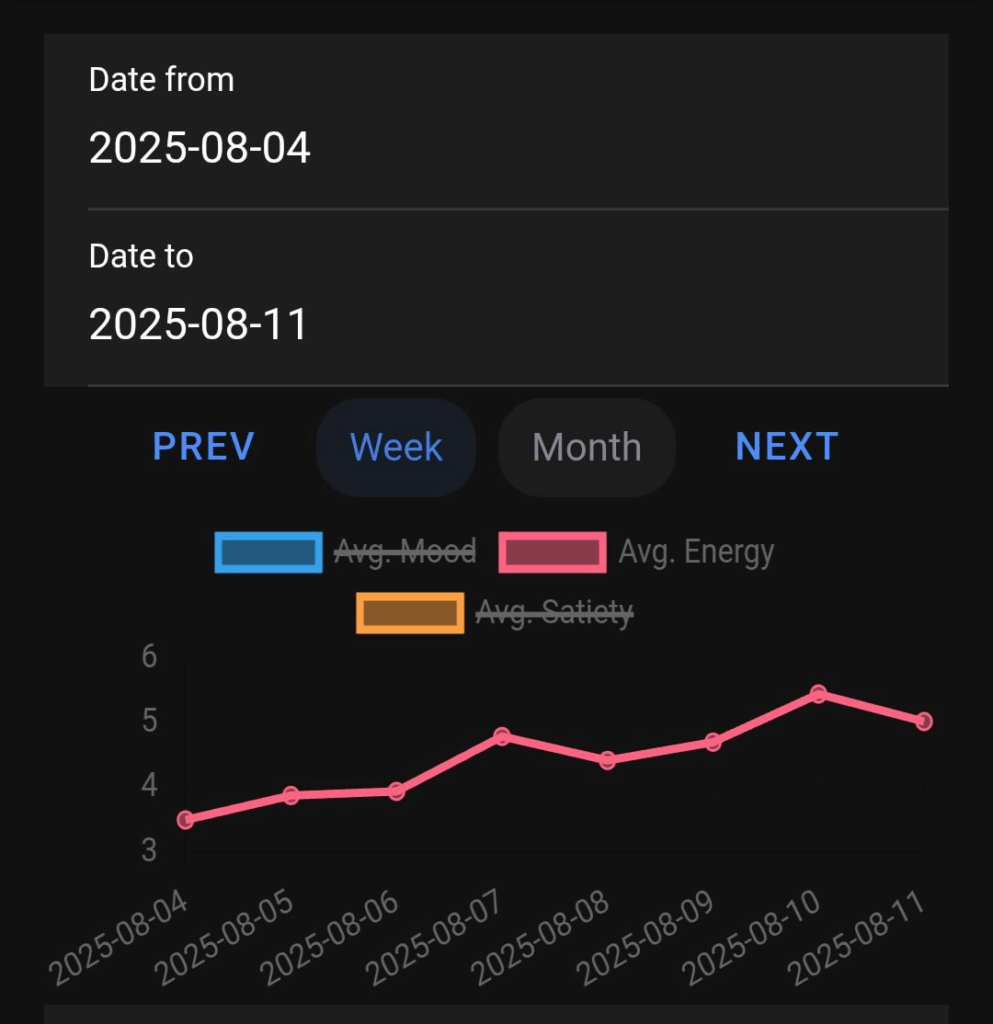
The higher energy level was, the more willpower I gained. Of course, the energy level couldn’t raise infinitely, and there were drops.
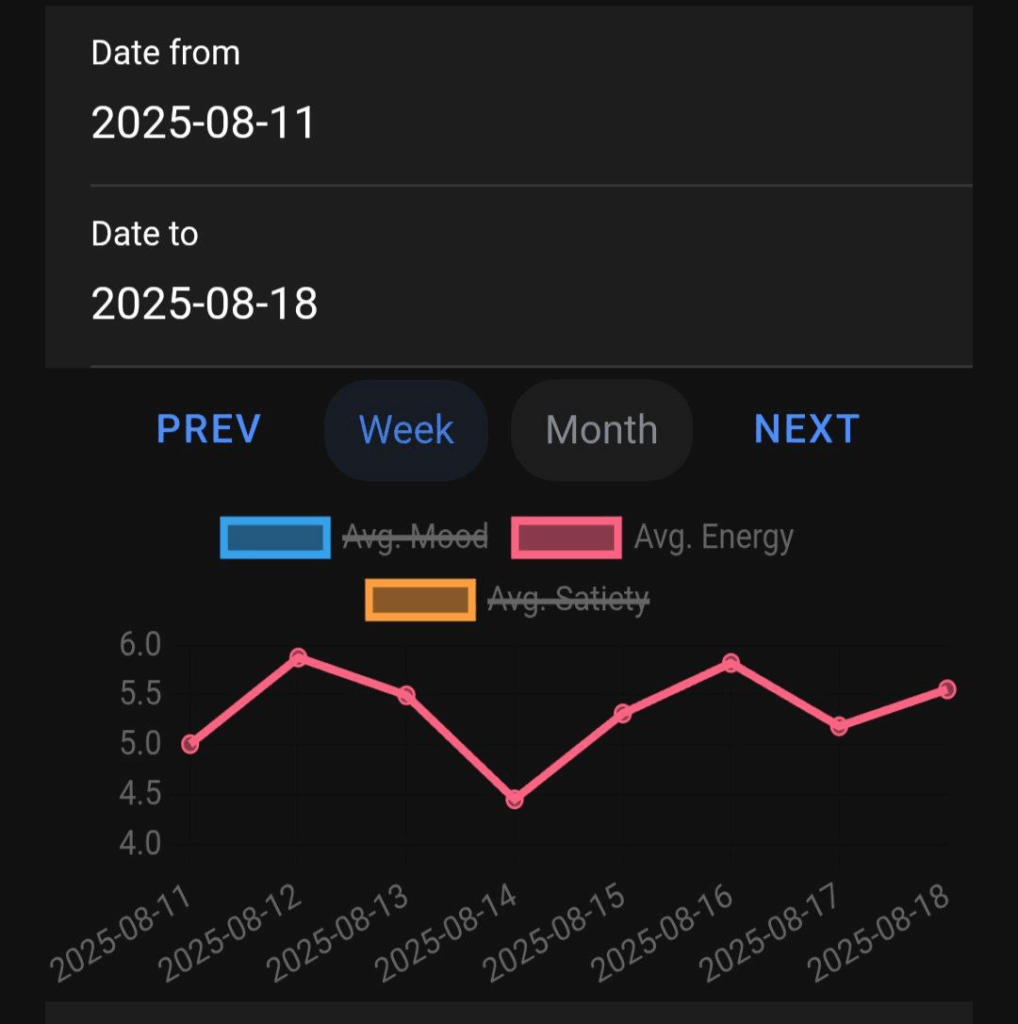
Some days are just bad. You can’t get rid of them totally. Continue to track even if you don’t feel like it. The next day you’ll see that your bad day was just a drop on the graph, nothing more.
A graph is a visual presentation, but you also can get average values for period of time in TrackLab.
My results:
| Week | Avg. energy |
|---|---|
| 1 | 4.4 |
| 2 | 5.3 |
| 3 | 5.6 |
| 4 | 5.6 |
| 5 | 5.4 |
Now my energy has increased to an average value of 6.3 and stays stable. It’s impossible to reach 10, because your energy inevitably drops throughout the day. The main goal here is reach a comfortable level and keep it.
Food
Problem
Despite the fact that I stabilized my sleep, there still was one problem. Even after 8 hours of sleep I regularly felt sleepy between 1 and 4 P.M. It seemed strange to me. In the morning I could feel that I was full of energy, but I didn’t get why it evaporated so quickly.
Then I recalled that I’d heard that carbohydrate consumption influences energy. And here comes my next bad habit – binge eating in the evenings.
Plan
My assumption was “when I binge eat in the evening, the next day I feel sleepy between 1 and 4 P.M.” And my next goal was to check that. I continued to track my energy and satiety levels to see any correlation.
It’s tricky, because there are many factors. For example, there was a period when I was sick:

I can’t trust this correlation.
For this problem I chose another tactics. I checked all the days when I slept more than once. Then I looked at what I ate in the evening of the previous day.

For example, there were two days, when I slept in the daytime – September 25 and 27.
Result
It turned out that on the evening of September 24 I ate too much and reached a satiety level of 9.
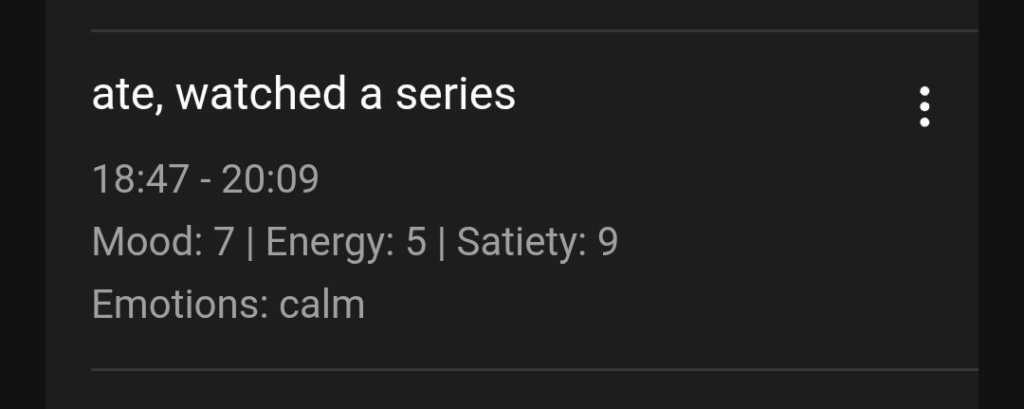
On September 26 I didn’t ate too much, but I ate right before going to bed.
After I started to control food consumption in the evenings, my daily drowsiness was gone.
Illness
I had a problem with my digestive system for some time. In some cases, digestive problems can be fixed with proper diet.
I started to write everything I ate in the comment section in TrackLab, and the next day I exported all my activities into an MD file. Then I sent the file to ChatGPT, and it pointed out mistakes in my diet. I followed his recommendations and sent new files. Every time it found fewer mistakes, and I felt better.
But if your problem can’t be fixed like that, you should go to a doctor. In that case you can also track your activity and specify information that your doctor would be interested in – diet, water consumption, sleep time, physical activity, etc. It depends on your problem.
Conslusion
TrackLab is a tool for tracking your time. You can come up with different scenarios for how you could use it. If you started to track your time or want to start, you can share your story. I’m interested to know if my app is useful to someone, and see how I could to improve it based on real cases.