

Before I started developing my tracking app, I asked myself one simple question: “Why should anyone track their time?” Without a clear answer, any further development would be pointless. Here’s what I found.
Self-development
I’m interested in the field of self-development because I always struggle with it. I procrastinate a lot. Sometimes I can get over it, but eventually, I return to my old behavior. And of course, when you’re interested in something, you consume a lot of related content. Have you ever watched a video about procrastination to procrastinate? That’s about me.
The content didn’t help me solve my problems. Obviously, reading and watching are not enough. Those are passive actions. I need to act by myself. But where to start? It’s a big question, and the abundance of information doesn’t make finding the answer easier.
Problem with content
Books and videos provide general information from other sources or directly from their authors’ heads to a wide audience. Sometimes they tell people what they want to hear. Sometimes they try to demonize or exaggerate things to shock the audience and get more views or sales. Sometimes they promise to solve all your problems. And so on.
Another problem already lies within us. We perceive information personally. A good example is in the screenshot.
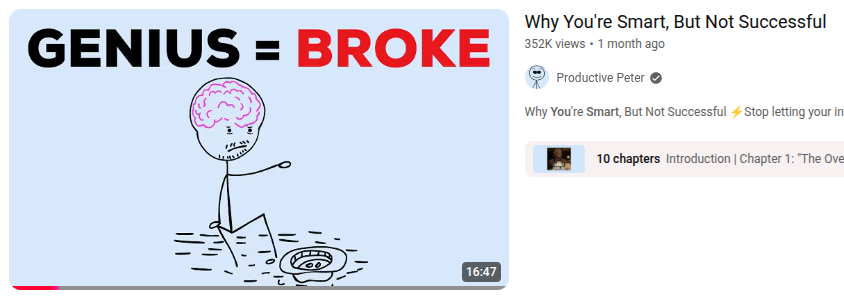
What’s the probability that you consider yourself smart and not successful? Let’s be honest – it’s not about brains or success; it’s about self-esteem. People with average or high self-esteem will find this video quite relevant no matter what it’s about.
It works like horoscopes. The general description attracts people because they find it personal. Don’t tell me you believe in horoscopes 😳.
Scientific method
Let’s come back to the question “Where to start?”
The best way to understand the world is through the scientific method. People haven’t come up with anything better yet – and probably never will.
The first step of scientific method is to Make an Observation. If you want to know yourself, you should observe yourself both from the inside and the outside.
For inside observation, you can use self-reflection. The best tool for self-reflection is your diary. There’s no secret to keeping a diary. You don’t need to watch another video with “10 tips on how to do it.” Just write the first things that come to mind. Your thoughts are the key.
For outside observation, you should track your behavior and physical state. For that purpose, you can use a tracking app, like TrackLab.
What’s next
The next step of the scientific method – Do Background Research – is already done. I’m sure that if you’re interested in self-development like me, you’ve already watched tons of videos and read stacks of books about it. That’s enough for now.
Choose one piece of advice you think is worth your time and Construct a Hypothesis. For example, you read “Make Your Bed” by William H. McRaven and decided to make your bed every morning. Your hypothesis could be: “If I make my bed every morning, my productivity will increase.”
Then Test Your Hypothesis by Doing an Experiment. Start making your bed and track your time every day. After some time (e.g., a month), Analyze Your Data and Draw a Conclusion. Your productivity is the ratio of useful to useless work. If it increased, that could mean that the advice is good – or at least harmless.
The last step – Communicate Your Results – is optional, because it’s your personal experience. You can keep it in secret if you want. But if many people shared their results, we could get some statistics about the advice.

Conclusion
External sources of information are too general. Even the best-designed research is not 100% accurate. There are always some people for whom a hypothesis doesn’t work. That’s why you should test advice instead of blindly trusting it.
TrackLab can help you with that. It’s free and doesn’t collect any data.